
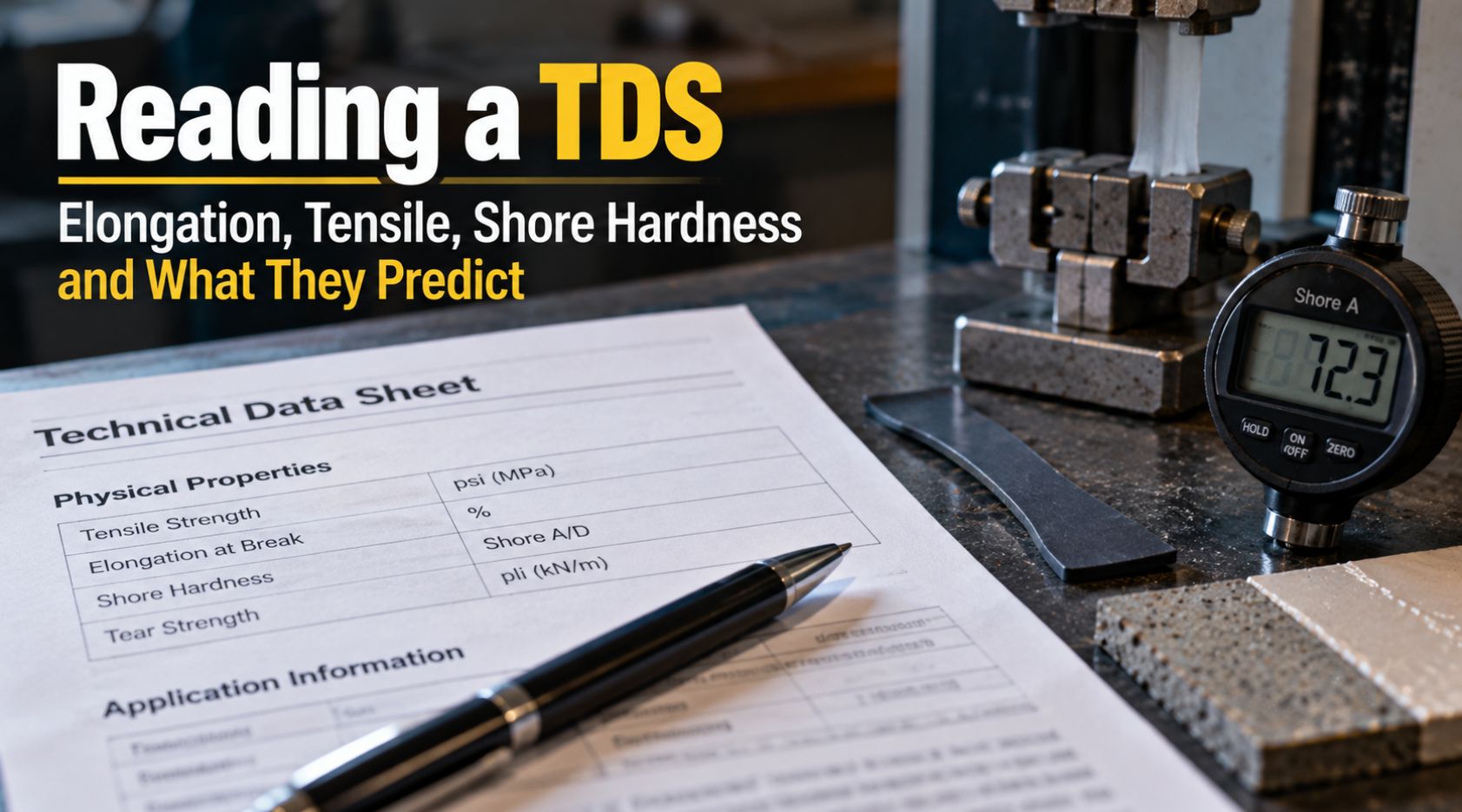
Reading a TDS: Elongation, Tensile, Shore Hardness, and What They Predict
Pull up almost any coating’s technical data sheet and you’ll find a cluster of numbers near the top: tensile strength, elongation at break, shore hardness, usually a few more. Most people glance at them, maybe notice one number looks impressively high, and move on to reading about coverage rates and cure times instead. That’s a mistake, because these three specs, more than almost anything else on the sheet, predict how a coating will actually behave under real-world stress, and misreading them, or ignoring them entirely, is a common reason a product performs differently in the field than expected.
This piece walks through what coating elongation and tensile strength numbers actually measure, what shore hardness adds to that picture, and how to read all three together instead of fixating on whichever number sounds most impressive in isolation.
Tensile Strength: What It Actually Measures
Tensile strength measures the maximum stress a cured coating film can withstand while being stretched before it breaks, typically tested according to ASTM D412 for elastomeric materials and expressed in pounds per square inch or megapascals. In plain terms, it’s a measure of how much pulling force the material can take before it tears apart.
Here’s where a lot of people misread this number: higher tensile strength doesn’t automatically mean a “better” or “tougher” coating in every practical sense. A high tensile strength material resists being pulled apart under load, which matters enormously for applications facing sustained mechanical stress, but tensile strength alone says nothing about how the material behaves under impact, how it handles a substrate that’s flexing or moving, or how it performs under repeated stress cycling rather than a single pull-to-failure test.
Elongation: The Number That Tells You About Flexibility
Elongation at break, also measured under ASTM D412, expresses how much a material can stretch, as a percentage of its original length, before it fails. A coating with 300 percent elongation can stretch to four times its original length before breaking. This is the number that predicts flexibility, crack resistance, and how well a coating will track substrate movement without failing.
Coating elongation and tensile strength tend to trade off against each other in formulation chemistry, though not in a strict, universal inverse relationship. Generally, formulations optimized heavily for high tensile strength sacrifice some elongation, becoming stiffer and less able to stretch, while formulations optimized for high elongation tend to have somewhat lower tensile strength, prioritizing flexibility over raw pull-apart resistance. Understanding this tradeoff is central to reading a TDS correctly, since neither number in isolation tells you whether a product fits your application, and a coating optimized at one extreme of this tradeoff can be a poor fit for an application that actually needed balance between the two.
Why the Tensile-Elongation Relationship Matters for Real Applications
Consider two hypothetical coatings. One has high tensile strength and relatively low elongation, strong resistance to being pulled apart, but limited stretch before failure. The other has lower tensile strength but high elongation, more give before it breaks, but less resistance to sustained pulling force.
For a rigid substrate that won’t move or flex significantly, the higher tensile, lower elongation option might perform perfectly well, since the coating isn’t being asked to stretch much in service. For a substrate that expands, contracts, or flexes, a cracking concrete slab, a metal structure experiencing thermal cycling, a joint that moves, the higher elongation option is often the better match, since it can accommodate that movement without cracking, even though its raw tensile number looks less impressive on paper.
This is exactly the kind of judgment call that gets missed when someone picks a coating based on which spec sheet has the biggest tensile strength number rather than thinking through what the actual application demands. Our piece on the isocyanate-amine reaction that gives polyurea its properties covers the underlying chemistry that determines where a given formulation lands on this tensile-elongation spectrum in the first place, which is useful background for understanding why different products land where they do on a TDS.
Shore Hardness: A Different Kind of Measurement Entirely
Shore hardness measures a material’s resistance to indentation, essentially how hard or soft the cured film is, using a durometer test on either the Shore A scale, for softer, more flexible materials, or the Shore D scale, for harder, more rigid ones. This is a genuinely different property from tensile strength and elongation, even though people sometimes conflate hardness with toughness or durability in casual conversation.
A high Shore hardness reading generally correlates with better abrasion and indentation resistance, resisting scratches, punctures from sharp objects, and general surface wear from foot or vehicle traffic. But hardness and flexibility are often, though not always, inversely related, so a very hard coating can also be a less flexible one, more prone to cracking under substrate movement than a softer, more elastomeric formulation with a lower hardness reading but higher elongation.
Reading All Three Together
The real skill in reading a TDS isn’t memorizing what each individual number means, it’s understanding how the three properties interact to predict actual field performance for a specific application.
A floor coating expecting heavy foot and vehicle traffic on a stable, non-flexing substrate generally benefits from higher hardness and reasonable tensile strength, prioritizing wear and indentation resistance over extreme flexibility, since the substrate itself isn’t demanding much stretch from the coating. A coating for a cracking or actively moving substrate, an aging bridge deck, a tank subject to thermal cycling, benefits more from high elongation and adequate tensile strength, even at the cost of somewhat lower hardness, since flexibility to track that movement matters more than surface hardness in that specific context.
Neither combination is universally “better.” The right combination depends entirely on what the substrate and service conditions actually demand, which is exactly why comparing two products purely on which has the higher tensile number, without considering elongation and hardness together, leads to a mismatched product choice more often than people realize. Our comparison of pure polyurea versus hybrid formulations covers a related version of this problem, where buyers focus on one headline spec or claim without understanding the fuller performance picture a proper TDS review would reveal.
A Practical Reading Framework
When evaluating a TDS for a specific project, working through a few questions in sequence tends to produce a better match than scanning for the biggest number. What will the substrate actually do, stay rigid, or flex, crack, and move? That answer points toward whether elongation should be weighted more heavily than raw tensile strength. What kind of surface wear will the coating face, heavy abrasion and impact, or minimal foot traffic? That answer points toward how much hardness actually matters for this specific application. And finally, does the combination of all three numbers, not any single one, align with what similar successful projects in this application category have used, rather than assuming a coating with an impressively high number in one category will automatically perform well across the board.
Comparing Coating Property Profiles
| Property | What It Measures | High Value Favors | Tradeoff Consideration |
|---|---|---|---|
| Tensile strength | Resistance to pulling force before failure | Sustained load-bearing applications | Can trade off against elongation |
| Elongation at break | Percentage stretch before failure | Flexible, moving, or cracking substrates | Can trade off against tensile strength and hardness |
| Shore hardness | Resistance to indentation and surface wear | Heavy abrasion, high-traffic surfaces | Can trade off against flexibility |
Things to Consider Before Comparing Products by Spec Sheet
- Does the substrate move, flex, or crack in service, favoring a higher-elongation formulation over one optimized purely for tensile strength?
- What kind of surface wear will the coating actually face, and does the shore hardness reading match that demand?
- Are you comparing all three specs together, or fixating on a single impressive-sounding number from one product’s TDS?
- Has the specific test method and conditions been checked, since testing standards and conditions can affect how comparable two products’ numbers actually are?
- Does the formulation’s general chemistry, aliphatic versus aromatic, pure versus hybrid, help explain why it lands where it does on these three properties? Our piece on aliphatic versus aromatic chemistry and our comparison of polyaspartic versus polyurea both touch on how underlying chemistry choices show up in these kinds of physical property differences.
Frequently Asked Questions
Is higher tensile strength always better in a coating?
Not necessarily. Higher tensile strength often comes with a tradeoff in elongation, meaning a very high-tensile coating may be less flexible and more prone to cracking under substrate movement than a formulation balanced more toward elongation.
What does elongation at break actually tell you?
It tells you how much a coating can stretch, as a percentage of its original length, before it fails, which is the key indicator of how well it will handle a flexing, moving, or cracking substrate without breaking.
Does higher shore hardness mean a more durable coating?
It generally means better resistance to indentation, scratching, and surface abrasion, but not necessarily better overall durability, since a harder coating is often less flexible and can be more prone to cracking under substrate movement than a softer, higher-elongation alternative.
Can two coatings with the same tensile strength perform very differently?
Yes, easily, if their elongation and shore hardness values differ significantly, since tensile strength alone doesn’t capture flexibility or wear resistance, both of which matter enormously depending on the application.
How should I actually use these three numbers when choosing a coating?
Start with what the substrate and service conditions actually demand, movement, wear, impact, then look at all three properties together rather than picking based on whichever single number looks most impressive on a spec sheet.
Conclusion
Coating elongation and tensile strength, along with shore hardness, aren’t just numbers to skim past on the way to the coverage rate section of a technical data sheet. Read together, they predict how a coating will actually behave under the specific mechanical demands of a real application, and reading them in isolation, or chasing whichever number looks biggest, is one of the more common and most avoidable ways a coating ends up mismatched to the job it was chosen for.