
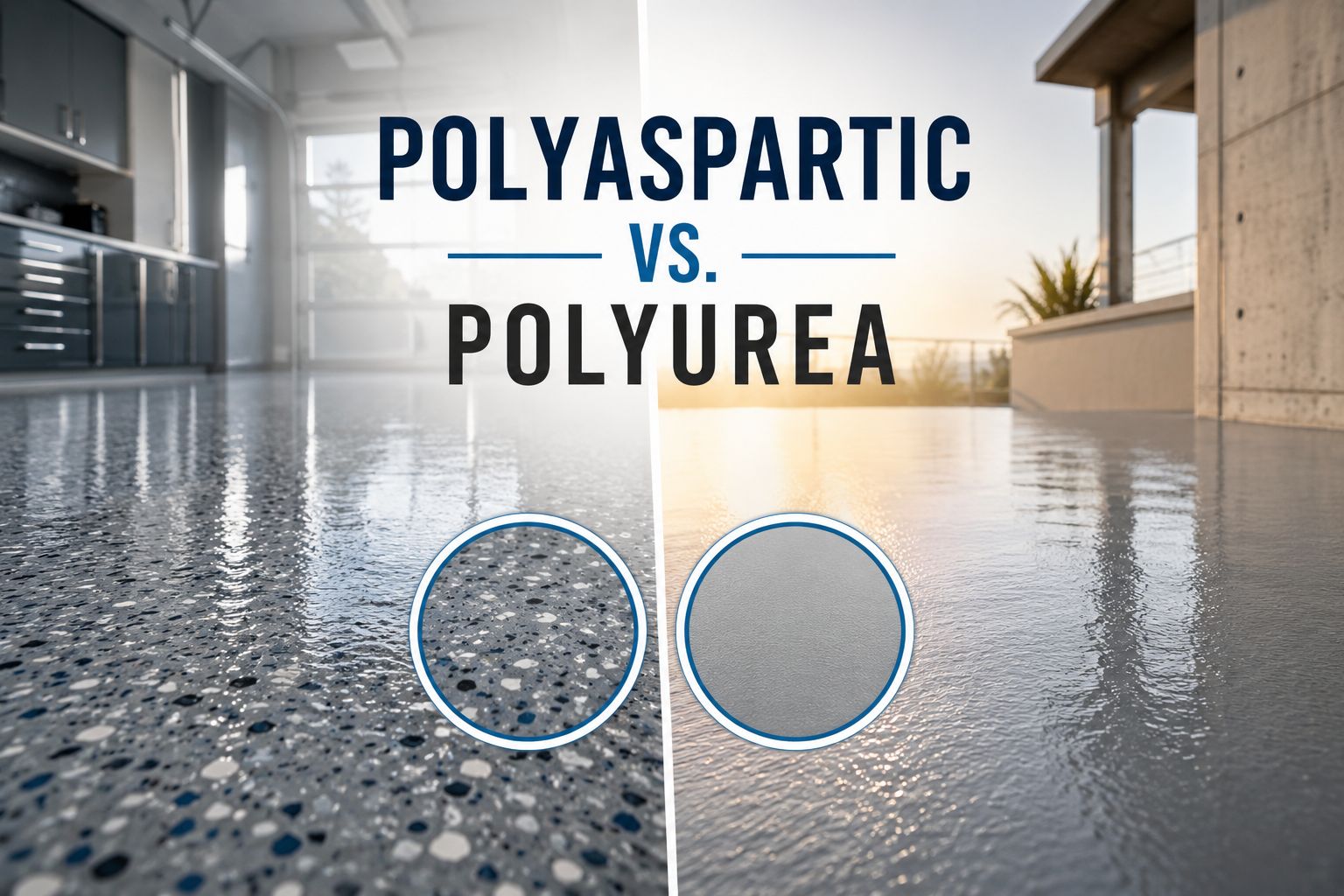
Polyaspartic vs. Polyurea: Cure Windows, UV, and Where Each Fits
Ask around a jobsite and you’ll hear “polyaspartic” and “polyurea” used almost interchangeably, sometimes even by people who should know better. That mixing up matters more than it might seem, because the two chemistries behave differently in ways that directly affect a project’s outcome: how much working time an applicator has, whether the finish will hold its color in direct sun, and which one actually belongs on a given surface.
This guide breaks down the real differences between polyaspartic and polyurea, focusing on the three factors that matter most in practice: cure window, UV stability, and where each one genuinely fits best, so the next quote you read or spec you write reflects an actual understanding of what’s being proposed rather than a term used loosely.
Understanding the Basics
Polyurea and polyaspartic aren’t entirely separate material families the way the naming confusion sometimes suggests. Polyaspartic coatings are technically a subtype within the broader polyurea chemistry, formulated using aspartic ester resins reacted with an isocyanate component. What sets polyaspartic apart is that specific resin chemistry, which changes reaction speed and final film properties compared to more standard polyurea formulations.
Standard polyurea, particularly fast-set formulations used in spray applications like protective linings and industrial floors, reacts extremely quickly, often curing to a tack-free state within seconds to minutes. Polyaspartic formulations can be engineered to react more slowly, giving applicators a longer working window before the material sets, which changes how and where each one gets used in practice.
Cure Window: The Practical Difference
This is where the two chemistries diverge most noticeably on an actual jobsite. Fast-reacting pure polyurea systems are prized for their speed, curing to a walkable or serviceable state in a very short window, which is exactly why they’re common for high-volume spray applications like bedliners, tank linings, and large industrial floors where minimizing downtime matters.
Polyaspartic systems, particularly those formulated as topcoats or floor systems, generally offer a longer, more controllable working window. That extended pot life gives an applicator more time to work the material, achieve a smoother finish, and handle detail work like edges and transitions without racing against an extremely short set time. This makes polyaspartic a common choice for projects where finish quality and working precision matter more than raw application speed, such as decorative garage floors or showroom-quality industrial coatings.
Neither cure speed is universally better. A fast cure is an advantage when minimizing downtime is the priority. A longer working window is an advantage when finish quality and detail work are the priority. Matching the cure characteristic to the actual project need, rather than defaulting to whichever material a contractor happens to stock, makes a real difference in the finished result.
UV Stability: Where the Chemistry Really Shows
UV stability is arguably the most practically important difference between the two, and it comes down to the type of isocyanate used in the formulation. Aliphatic isocyanates, common in polyaspartic formulations, are inherently more UV stable, resisting the yellowing and chalking that aromatic isocyanates are prone to under sustained sun exposure. Aromatic isocyanates, more common in standard fast-set polyurea base coats, are generally less expensive and react faster, but they yellow and degrade under UV exposure without additional protection.
This is why polyaspartic coatings are frequently used as a topcoat over a base polyurea layer specifically to add UV stability that the underlying coating doesn’t have on its own. A polyurea base coat handles the structural, bonding, and durability requirements, while a polyaspartic topcoat protects that base layer from UV-related discoloration and surface degradation, particularly for any application with direct sun exposure.
For interior applications with minimal UV exposure, this distinction matters less, and a straight polyurea system without a UV-stable topcoat may perform perfectly well. For any exterior or sun-exposed application, skipping the UV-stable layer is one of the more common and most visible mistakes, since the coating may perform structurally fine while looking noticeably yellowed or chalky within a relatively short time.
Where Each One Fits
Fast-set pure polyurea tends to fit:
- High-volume spray applications where minimizing downtime is the priority
- Interior applications with minimal UV exposure
- Structural or protective linings, such as tank interiors or secondary containment, where UV resistance isn’t a factor
- Projects requiring rapid return to service
Polyaspartic tends to fit:
- UV-exposed exterior applications, or as a topcoat over a base polyurea system
- Decorative and showroom-quality floor coatings where finish detail matters
- Projects where a longer working window improves application quality
- Situations calling for better color retention and gloss stability over time
Confusion between the two, and specifically what a given quote or product actually contains, is a common source of buyer frustration. Our piece on pure polyurea versus hybrid formulations covers a related version of this same confusion, where buyers assume they’re getting one chemistry when the actual product is something else entirely.
Comparison Table
| Factor | Fast-Set Polyurea | Polyaspartic |
|---|---|---|
| Typical cure speed | Very fast, seconds to minutes | Slower, more controllable working window |
| UV stability | Generally lower unless aliphatic formulation used | Generally higher, aliphatic-based |
| Common isocyanate type | Often aromatic | Often aliphatic |
| Typical role | Base coat, structural lining, high-volume spray work | Topcoat, decorative and UV-exposed finish work |
| Best for | Speed-critical, interior, or non-UV-exposed applications | Exterior finish work, detail-critical applications |
| Finish quality control | More limited by short working time | Generally easier to control finish detail |
How This Fits Into the Broader Polyurea vs. Polyurethane Confusion
The polyaspartic-versus-polyurea question is really one branch of a larger naming confusion in this industry. Polyurethane, polyurea, and polyaspartic all get used loosely in casual conversation, even though each represents a distinct chemistry with different performance characteristics. Our broader explainer on polyurea versus polyurethane chemistry covers that foundational distinction, which is worth understanding before getting into the more specific polyaspartic comparison covered here.
Things to Consider Before Choosing
- Will the coated surface see direct or significant indirect UV exposure, and does the chosen system account for that?
- Does the project prioritize application speed and minimal downtime, or finish quality and detail work?
- If using a fast-set polyurea base, has a UV-stable topcoat been specified for any exterior exposure?
- Has the contractor been specific about which exact chemistry is being quoted, rather than using “polyurea” as a catch-all term?
- Does the project’s exposure profile, chemical, mechanical, thermal, favor one chemistry’s typical strengths over the other?
Application Considerations
Beyond the material chemistry itself, application quality matters just as much for either system. Equipment calibration, ratio accuracy between the two components, and environmental conditions during application all affect the final result regardless of which chemistry is being sprayed. Our members’ Q&A on polyurea application equipment covers common equipment and calibration questions that apply to both polyurea and polyaspartic spray systems, since the plural-component spray process shares similar fundamentals across both chemistries.
A Practical Example: Exterior Structures Under Sustained UV Exposure
Agricultural and exterior industrial structures offer a useful illustration of why this chemistry distinction matters in practice. A structure coated with a fast-set polyurea base without any UV protection can perform structurally well while still degrading visibly at the surface within a relatively short exposure period, since the underlying mechanical properties and the surface appearance are affected by UV exposure differently. Our piece on grain bin coating as a protective investment touches on a related exterior, UV-exposed application where getting the topcoat decision right has a real, visible impact on how the coating holds up over time.
Maintenance and Long-Term Appearance
A properly specified system, base polyurea with a polyaspartic UV-stable topcoat where exposure calls for it, generally requires minimal maintenance beyond routine cleaning and periodic inspection for wear at high-traffic points. A system missing that UV protection where it was actually needed tends to show its age faster, with visible yellowing or chalking well before any structural failure would occur, which is often what prompts a premature recoat even though the underlying coating is still functionally sound.
Getting the Specification Right
Because “polyurea” gets used so loosely across the industry, precise language in a specification or contract matters more than it might seem. Specifying the exact chemistry, fast-set polyurea, a specific polyaspartic formulation, or a base-plus-topcoat system, rather than just “polyurea coating,” protects both the buyer and the contractor from a mismatch between what was expected and what actually gets delivered. This is especially important for exterior or UV-exposed projects, where the difference between an aliphatic and aromatic base isn’t visible on the day of installation but becomes very visible within the following year.
Frequently Asked Questions
Is polyaspartic the same thing as polyurea?
Not exactly. Polyaspartic is a specific subtype within the broader polyurea chemistry family, using aspartic ester resins that change reaction speed and UV performance compared to more standard polyurea formulations.
Which one cures faster?
Standard fast-set polyurea generally cures faster, often within seconds to minutes, while polyaspartic systems are typically formulated with a longer, more controllable working window.
Why is polyaspartic often used as a topcoat over polyurea?
Because polyaspartic’s typically aliphatic chemistry offers better UV stability than many standard polyurea base coats, protecting the underlying layer from yellowing and surface degradation under sun exposure.
Can polyurea alone handle UV exposure without a topcoat?
It depends on the specific formulation. Aliphatic polyurea formulations offer better inherent UV stability, but many common fast-set polyurea systems use aromatic chemistry and will yellow or chalk without additional UV protection.
Which chemistry is better for a decorative garage floor?
Polyaspartic is commonly preferred for decorative and showroom-quality floors, since its longer working window supports finer finish control and its UV stability holds color and gloss better over time.
Conclusion
Polyaspartic and polyurea aren’t competing chemistries so much as complementary ones, each suited to a different part of the job. Fast-set polyurea earns its place where speed and structural performance matter most, while polyaspartic earns its place where UV stability and finish quality are the priority, often working together as a base coat and topcoat system rather than as an either-or choice. Understanding which characteristic actually matters for a given project, rather than treating the two terms as interchangeable, is what leads to a coating system that performs the way it’s expected to for years rather than just on installation day.