
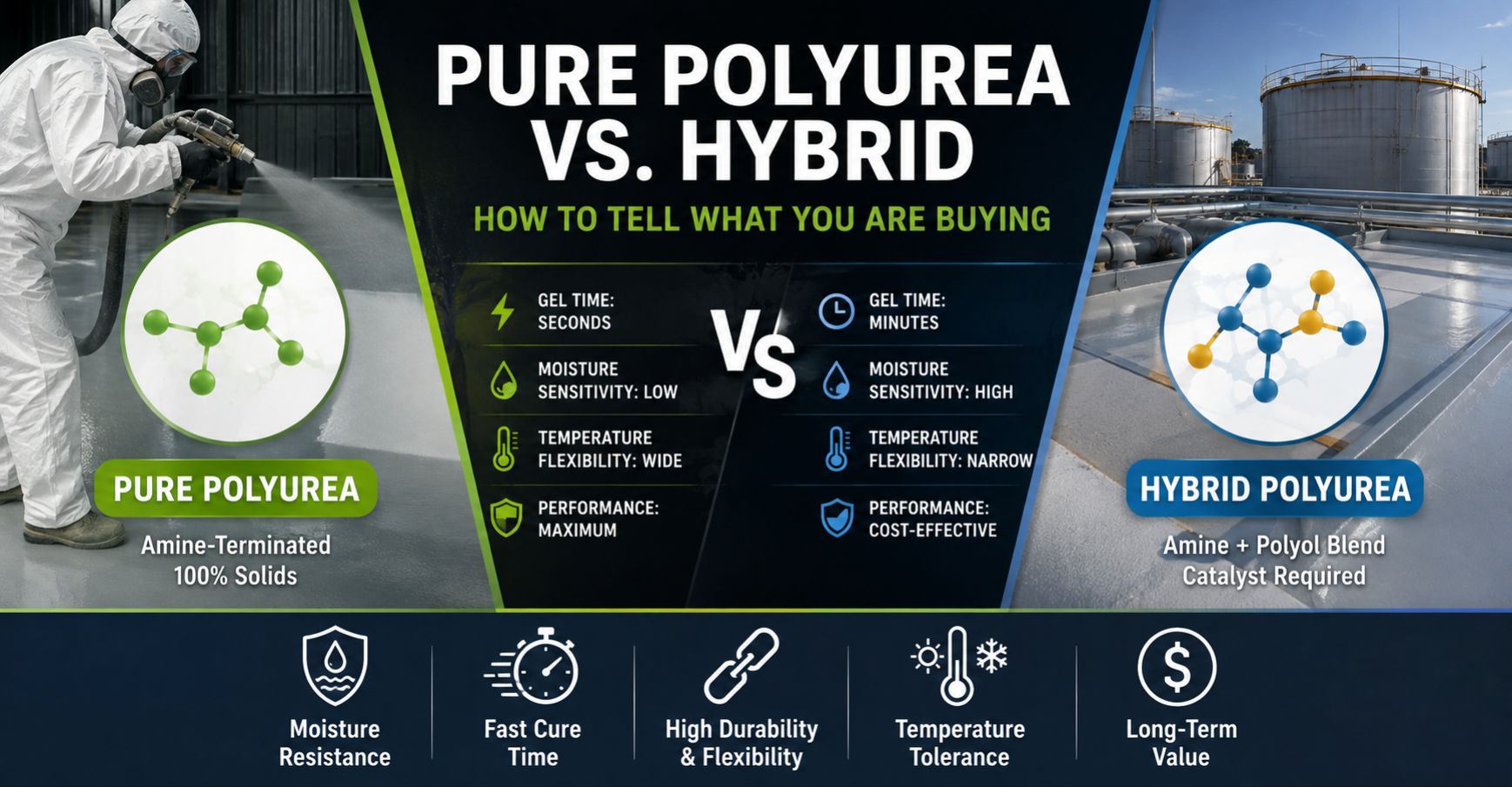
Pure Polyurea vs. Hybrid: How to Tell What You Are Buying
Polyurea” gets used as a catch-all term in the coatings market, and that is where a lot of buyers get confused. A contractor quoting a “polyurea coating” could be selling a fully reacted, moisture-insensitive pure polyurea system, or a hybrid formulation that behaves very differently under load, moisture, and temperature. Both are legitimate products with real applications. The problem is that they are not interchangeable, and a buyer who does not know the difference has no way to judge whether a quote reflects the right chemistry for the job or just the cheapest label to put on it. This article breaks down what separates pure polyurea from hybrid polyurea at the chemistry level, where each one fits, and what questions to ask before signing off on either one.
Understanding the Basics
Pure polyurea is the reaction product of an isocyanate component and an amine-terminated resin blend, with no polyol in the resin side. Because both sides react amine-to-isocyanate, the reaction proceeds without a catalyst and is largely indifferent to ambient moisture and temperature at the point of spray. That is what gives pure polyurea its defining trait: a gel time measured in seconds and a system that can be applied in a wider range of field conditions without the cure being thrown off.
Hybrid polyurea (sometimes called polyurea-polyurethane hybrid) blends a hydroxyl-terminated polyol into the resin side alongside the amine component. Because part of the reaction now involves a polyol reacting with isocyanate, the system needs a catalyst to drive the cure at a usable rate, and it becomes more sensitive to moisture and ambient temperature during application. Cure and tack-free time run longer than pure polyurea, typically minutes rather than seconds.
Neither formulation is inherently better. They are built for different jobs, and the chemistry drives real, practical differences in how each performs on a project.
Part of why this gets confusing at the point of sale is that both products can look and feel similar once cured, and both get marketed under the same “polyurea” umbrella. A buyer standing on a finished floor or looking at a cured tank lining cannot tell which chemistry they are looking at just by inspection. The differences show up later, in how the coating handles moisture intrusion, temperature swings, or long-term flexibility, which is exactly why the distinction matters most before the job starts, not after.
Key Differences
Reaction chemistry. Pure polyurea reacts amine-to-isocyanate only. Hybrid systems introduce a polyol into that reaction, which changes the cure mechanism.
Catalyst dependence. Pure polyurea does not require a catalyst to cure. Hybrid systems do, which introduces another variable that has to be controlled during production and application.
Moisture sensitivity. Pure polyurea is largely unaffected by moisture in the substrate or air during application. Hybrid systems are more sensitive to both, which narrows the window of conditions where a clean cure is reliable.
Cure and gel time. Pure polyurea gels in seconds and reaches a walkable state quickly. Hybrid systems take longer, generally several minutes to tack-free, which affects how fast a crew can move through a job and when the area can be returned to service.
Flexibility and elongation. Pure polyurea generally holds elongation and flexibility better across a wider temperature range. Hybrid systems can perform well within a narrower temperature band but tend to lose flexibility faster outside it.
Cost. Hybrid formulations are typically less expensive than pure polyurea, which is part of why they remain common on projects where the performance ceiling of pure polyurea is not actually needed.
Comparison Table
| Factor | Pure Polyurea | Hybrid Polyurea |
|---|---|---|
| Resin side | Amine-terminated only | Amine plus polyol |
| Catalyst required | No | Yes |
| Moisture sensitivity | Low | Higher |
| Gel time | Seconds | Minutes |
| Temperature flexibility | Wider range | Narrower range |
| Typical cost | Higher | Lower |
| Common use | High-performance, critical applications | Cost-sensitive, less demanding applications |
Best Use Cases
Pure polyurea tends to be specified where failure has a high cost or where field conditions cannot be tightly controlled: secondary containment, industrial tank linings, high-traffic industrial floors, and waterproofing on structures where moisture exposure during and after application is a given. It’s also the more common choice for roofing applications where fast return-to-service and consistent flexibility across seasonal temperature swings matter; our complete guide to polyurea roof coatings goes into how that plays out on an actual roofing project. Containment work is another area where the chemistry advantage shows up directly in the field, which we covered in more detail when looking at how polyurea has been adopted for secondary containment in oil and gas operations.
Hybrid polyurea shows up more often on projects where budget is a bigger constraint than peak performance: decorative garage floors, some truck bed liner applications, and interior work where moisture and temperature can be controlled during application. It can be a reasonable choice in the right setting, but it is not a drop-in substitute for pure polyurea on a project that was actually specified around pure polyurea’s properties.
Things to Consider Before You Buy
Ask for the actual product data sheet, not a sales description. “Polyurea” on a proposal does not tell you which chemistry is being quoted. The manufacturer’s technical documentation for the specific product should state whether it is a pure or hybrid system, along with gel time, tack-free time, and application temperature range.
Ask about the equipment being used. Pure polyurea’s fast gel time requires proportioning equipment capable of handling that reaction speed correctly, and ratio control matters more with a system that cures this quickly. If you want a sense of what applicators actually deal with on the equipment side, the panel discussion in our equipment Q&A covers the kind of ratio and temperature control questions that separate a properly run pure polyurea job from a problem one.
Confirm certifications for specific end uses. If the application involves contact with potable water, any product named for that use should carry a current, product-specific NSF/ANSI 61 listing. Don’t take a verbal assurance that “polyurea is fine for water tanks” as a substitute for that documentation, since the certification applies to a specific formulation, not to polyurea as a category.
Match the chemistry to the exposure, not the price. A hybrid system priced lower than a pure polyurea quote is not automatically a bad deal, but it needs to fit what the surface will actually be exposed to. A hybrid coating in a application that calls for pure polyurea’s moisture tolerance and flexibility range is where premature failures tend to originate.
Maintenance
Both pure and hybrid polyurea coatings are generally low-maintenance once properly cured and bonded, but neither is maintenance-free. Periodic inspection for surface abrasion, impact damage, or seam issues at penetrations and terminations catches problems while they are still a spot repair rather than a full recoat. Cleaning recommendations and any topcoat recoat intervals should come from the specific product’s technical documentation, since UV exposure and abrasion resistance vary by formulation and by whether a UV-stable topcoat was applied over the base coat.
Frequently Asked Questions
Is hybrid polyurea a lower-quality product?
Not inherently. It is a different chemistry suited to different conditions and budgets. It becomes a problem only when it’s substituted for pure polyurea on a job that was specified around pure polyurea’s moisture tolerance or flexibility.
Can hybrid polyurea be used outdoors?
It can, but application conditions need to be more tightly controlled than with pure polyurea because of its higher moisture and temperature sensitivity during cure.
How can I tell which one a contractor is actually quoting?
Ask for the product’s technical data sheet by name, not a general description. The data sheet will state the resin chemistry, gel time, and application conditions.
Does faster cure time mean better performance?
Not by itself. Cure speed affects scheduling and how quickly an area returns to service, but it is not a direct measure of long-term durability or chemical resistance.
Is pure polyurea always the right choice?
No. It’s the right choice where the exposure and performance demands call for it. Paying for pure polyurea on a project that does not need its properties is not a better outcome, just a more expensive one.
What happens if a hybrid system is used where pure polyurea was specified?
It depends on the exposure, but this is where premature failures tend to show up, typically as reduced flexibility, cracking under thermal cycling, or coating breakdown from moisture the hybrid system was not built to tolerate. If a substitution happens, it should be a documented decision, not a quiet swap on the invoice.
Conclusion
The difference between pure and hybrid polyurea comes down to chemistry, and that chemistry has direct, practical consequences for cure speed, moisture tolerance, flexibility, and cost. Neither one is the universally correct answer. The right approach is asking for actual product documentation, understanding what the project’s exposure and performance requirements actually are, and matching the chemistry to those requirements rather than to whichever term shows up first on a proposal.