
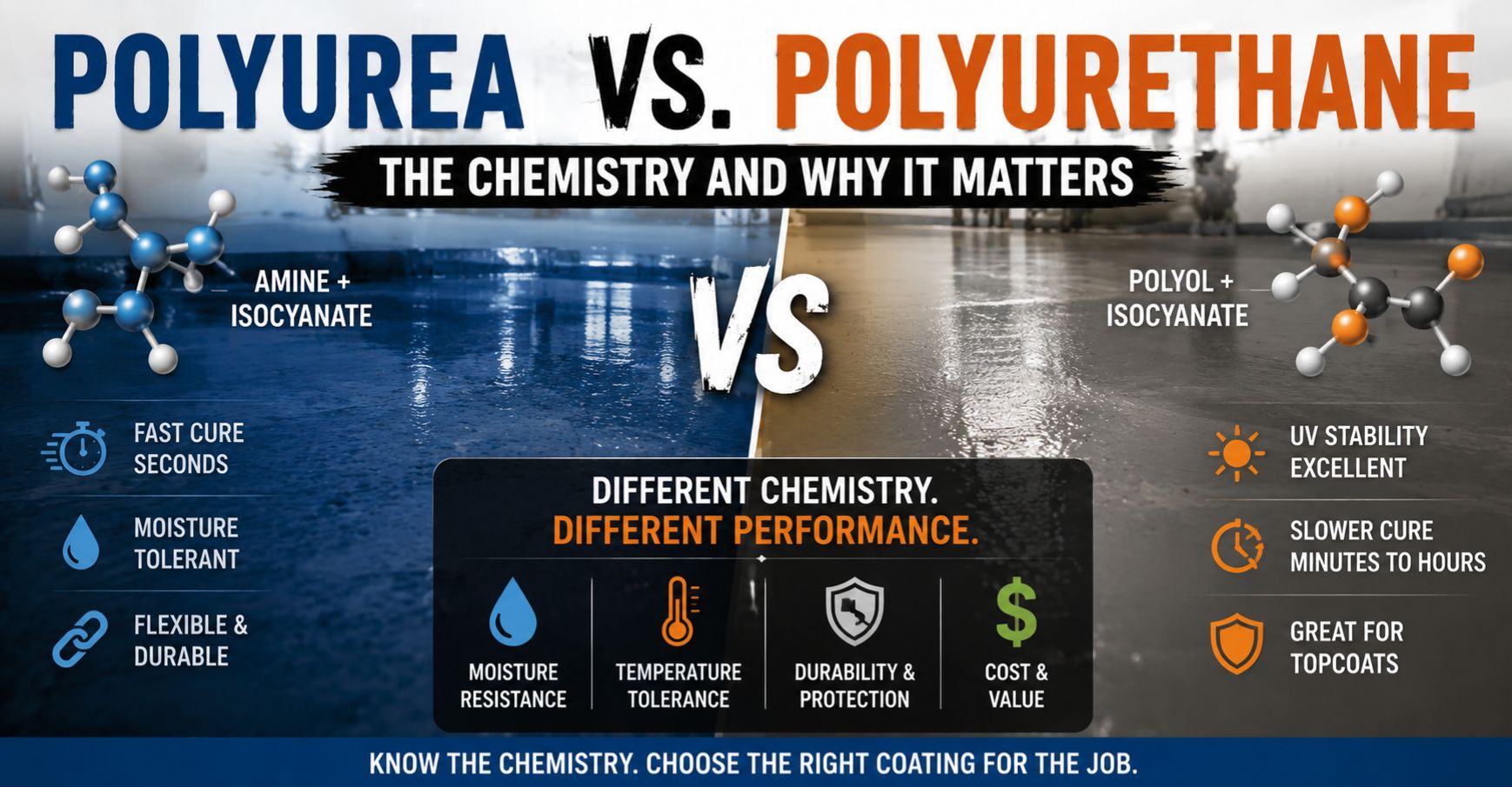
Polyurea vs. Polyurethane: The Chemistry and Why It Matters
When comparing polyurea vs. polyurethane, many people assume the two terms refer to the same type of coating. In reality, they represent different chemistries, and that confusion often carries over into job sites, product specifications, and even contractor quotes.
It is an understandable mix-up. Both are used as protective and waterproofing coatings, both can look similar once cured, and both terms show up on the same product spec sheets. But they are built from different chemistry, they cure differently, and they hold up differently under moisture, temperature, and time. For anyone specifying a coating, or paying for one, knowing which chemistry is actually being applied is the difference between a system that matches the job and one that was chosen because the name sounded familiar.
Polyurea vs. Polyurethane: Understanding the Basics
Polyurethane is the reaction product of a polyol, a hydroxyl-terminated compound, with an isocyanate. That reaction generally needs a catalyst to proceed at a workable rate, and it is sensitive to moisture and ambient humidity during application, since water can react with isocyanate and interfere with the intended cure. Polyurethane cures more slowly than polyurea, typically over a period of minutes to hours depending on the formulation, and it is well known for holding up well under UV exposure, which is why it shows up so often as a clear or pigmented topcoat over other coating systems.
Polyurea, in its pure form, is the reaction product of an amine-terminated resin with an isocyanate, with no polyol involved. That amine-to-isocyanate reaction does not need a catalyst and is largely unaffected by moisture, which is what gives pure polyurea its signature trait: a gel time measured in seconds and a cure that holds up in field conditions polyurethane would struggle with. There is also a middle ground, hybrid polyurea, which blends a polyol into the resin side and behaves more like a bridge between the two chemistries. We covered that distinction in more depth in Pure Polyurea vs. Hybrid: How to Tell What You Are Buying, which is worth reading alongside this one if the product on your quote is a hybrid rather than a straight polyurethane or pure polyurea.
Polyurea vs. Polyurethane: Key Differences
Reaction chemistry. Polyurethane reacts polyol-to-isocyanate. Polyurea, in its pure form, reacts amine-to-isocyanate. That single difference is the root of almost everything else on this list.
Catalyst dependence. Polyurethane generally requires a catalyst to cure at a usable rate. Pure polyurea does not.
Moisture sensitivity. Polyurethane’s cure can be disrupted by moisture in the substrate or ambient air. Pure polyurea is largely indifferent to it, which is why it gets specified on projects where conditions cannot be tightly controlled.
Cure speed. Polyurethane cures over minutes to hours. Pure polyurea gels in seconds and reaches a walkable or return-to-service state far faster.
UV stability. Polyurethane holds color and gloss under UV exposure noticeably better than polyurea in most formulations, which is the main reason it is so commonly used as a topcoat rather than a base coat.
Flexibility and elongation. Polyurea, particularly pure polyurea, generally maintains flexibility across a wider temperature range. Polyurethane can become more brittle at temperature extremes depending on the specific formulation.
Abrasion and impact resistance. Both perform well here, but the specifics vary by product and film thickness, which is why the manufacturer’s technical documentation for the exact product in question matters more than a general chemistry comparison.
Cost. Pure polyurea systems generally carry a higher material cost than standard polyurethane systems, driven partly by the raw material cost of the amine resin side and partly by the specialized proportioning equipment required to handle its fast reaction. That cost difference is one reason polyurethane remains common even on projects where polyurea’s moisture tolerance would be a nice-to-have rather than a strict requirement.
Comparison Table
The table below summarizes the most important differences between polyurea and polyurethane, making it easier to compare their performance at a glance.
| Factor | Polyurethane | Pure Polyurea |
|---|---|---|
| Reaction | Polyol + isocyanate | Amine + isocyanate |
| Catalyst required | Usually | No |
| Moisture sensitivity | Higher | Low |
| Cure speed | Minutes to hours | Seconds |
| UV stability | Strong | Weaker without a topcoat |
| Flexibility across temperature | Narrower range | Wider range |
| Common role | Topcoat, clearcoat, finish layer | Base coat, structural waterproofing |
Best Use Cases
Polyurethane is the common choice for UV-exposed topcoats over another base system, decorative floor finishes where gloss and color retention matter, and applications where a slower, more controlled cure fits the job schedule. It shows up frequently layered over polyurea base coats specifically to add the UV resistance polyurea alone typically lacks.
Pure polyurea tends to be specified where fast return-to-service matters, where field conditions cannot be tightly controlled, or where flexibility across a wide temperature swing is a real requirement, secondary containment and industrial tank linings being two common examples; our piece on how polyurea has been adopted for secondary containment in oil and gas operations walks through why that shift happened. It is also common on roofing projects for the same reasons, which we cover in more detail in our guide to polyurea roof coatings.
In practice, a lot of well-built systems use both: a polyurea base coat for speed, flexibility, and waterproofing, with a polyurethane topcoat layered over it for UV stability and finish quality. Neither chemistry is a universal answer on its own, which is part of why so many specs call for both in the same system.
Things to Consider
Ask which layer is which. If a system uses both chemistries, find out specifically what the base coat is and what the topcoat is, and get that in writing on the spec sheet rather than a general “polyurea/polyurethane system” description.
Don’t assume UV stability from the base coat. A polyurea base without a UV-stable topcoat will chalk and discolor under sun exposure over time. If the project is outdoors and long-term appearance matters, confirm a proper topcoat is part of the spec.
Check the equipment and mix ratio requirements. Pure polyurea’s fast gel time demands proportioning equipment that can keep up with the reaction speed, and getting the ratio wrong shows up fast in a failed cure. Applicators who work with both chemistries regularly will have opinions worth asking about here.
Get the actual technical data sheet. Marketing copy calling something “polyurea” or “polyurethane” does not tell you the cure profile, moisture sensitivity, or temperature range. The manufacturer’s technical documentation for the specific product will.
Maintenance
Maintenance needs differ mainly around UV exposure. A polyurethane topcoat or a properly topcoated polyurea system holds gloss and color longer under sun exposure and needs less frequent recoating for appearance alone. An uncoated polyurea base left exposed will chalk over time even though the underlying waterproofing and structural performance may still be intact. Either way, periodic inspection for abrasion, impact damage, and seam integrity at penetrations catches problems early, and any recoat intervals should come from the specific product’s technical documentation rather than a general rule of thumb.
Frequently Asked Questions
Is polyurea just a type of polyurethane?
No. They are related but distinct chemistries. Polyurea reacts through an amine, polyurethane through a polyol, and that difference drives real performance differences in cure speed and moisture sensitivity.
Can polyurea and polyurethane be used together?
Yes, and it is common. A polyurea base coat paired with a polyurethane topcoat is a widely used combination that plays to each chemistry’s strengths.
Which one is more UV stable?
Polyurethane generally holds up better under UV exposure without additional protection. Polyurea is more commonly protected with a UV-stable topcoat when it will be exposed outdoors long-term.
Which one cures faster?
Pure polyurea, by a wide margin. Gel times for pure polyurea are measured in seconds, while polyurethane systems generally take minutes to hours.
Does faster cure mean better performance?
Not on its own. Cure speed affects scheduling and return-to-service time, but long-term durability depends on the full system design, substrate prep, and the specific products used.
Is one of these always the better choice?
No. They solve different problems. Treating either one as the automatic right answer, instead of matching the chemistry to the exposure and schedule the project actually has, is where mismatched specs tend to start.
Conclusion
Polyurea and polyurethane are not interchangeable terms, even though they get treated that way in casual use. The chemistry behind each one drives real differences in cure speed, moisture tolerance, UV stability, and flexibility, and a lot of the best-performing systems actually use both, in the right order, for the right reasons. The way to avoid a mismatch is the same as with any coating decision: ask for the actual technical documentation, confirm which chemistry is doing which job in the system, and match that to what the project will actually be exposed to.