
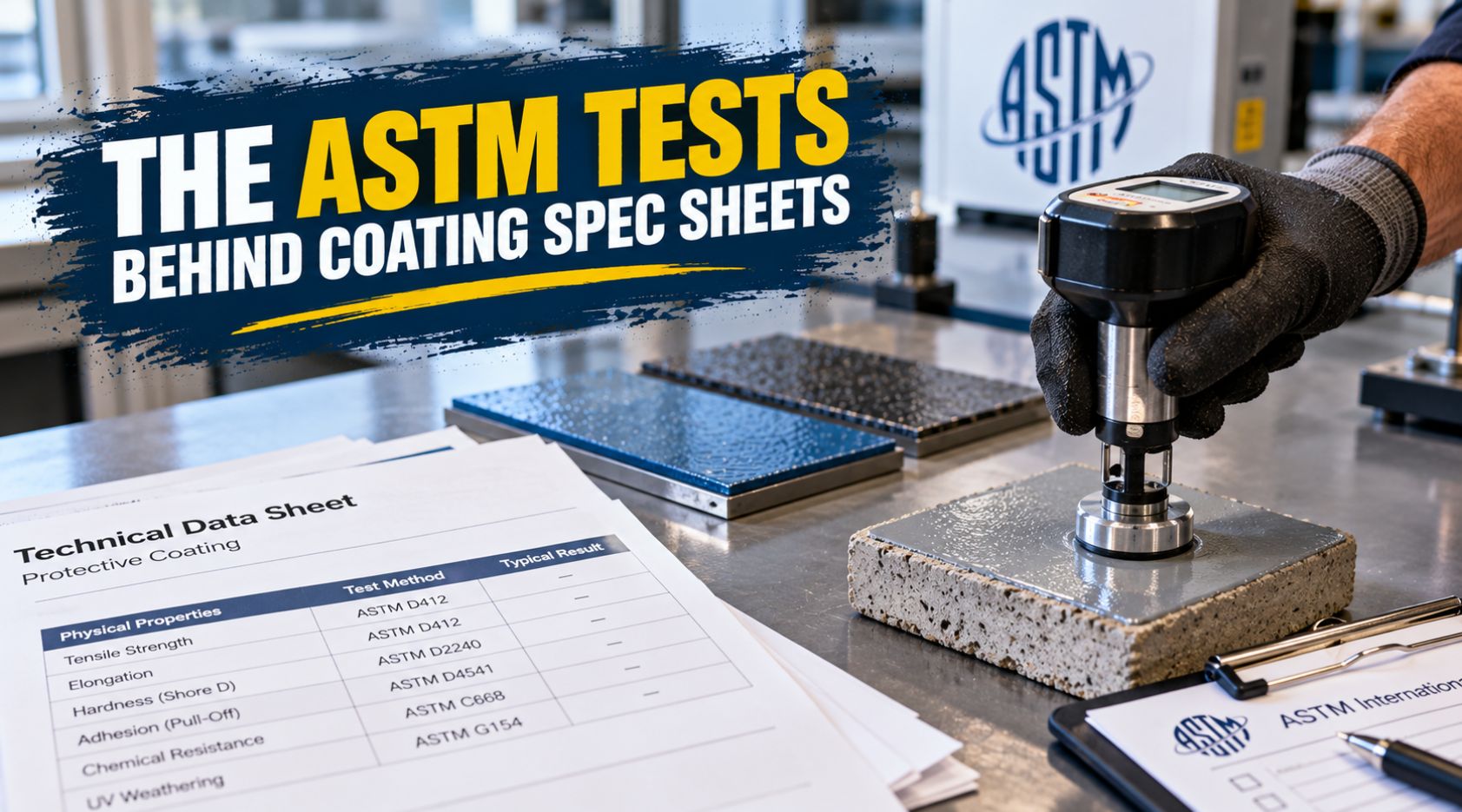
The ASTM Tests Behind Coating Spec Sheets
Pull up almost any protective coating’s technical data sheet and you’ll find a column of numbers next to a string of letters and digits, D412, D2240, D4541, and half a dozen others, sitting there like a secret code most buyers skim right past. Those codes are ASTM test method designations, and they’re actually the most honest part of the entire document, more honest, usually, than the marketing language surrounding them. Understanding what these ASTM standards for protective coatings actually measure turns a spec sheet from an intimidating wall of numbers into a genuinely useful tool for comparing products on something more solid than a sales pitch.
This guide walks through what ASTM actually is, how ASTM standards for protective coatings differ from certification or regulatory approval, the specific test methods that show up most often on coating spec sheets, and how to read them without getting misled by how they’re often presented.
What ASTM Actually Is
ASTM International, formerly known as the American Society for Testing and Materials, is a voluntary consensus standards organization, not a government regulatory body. It develops standardized test methods through committees of industry experts, and manufacturers who reference an ASTM test method on a spec sheet are saying their product was evaluated using that specific, repeatable procedure, which at least means the number represents something measured consistently rather than an arbitrary marketing claim.
It’s worth being clear about what this does and doesn’t guarantee. ASTM doesn’t certify products, and referencing a test method doesn’t mean an independent third party verified the result, unless the spec sheet specifically states that testing was performed by an accredited, independent lab. A manufacturer can run its own internal testing using a proper ASTM method and report the result honestly, which is common and legitimate, but it’s a different level of assurance than third-party verified data, and knowing which one you’re looking at matters.
The Tests That Show Up Most Often on Coating Spec Sheets
ASTM D412 measures tensile strength and elongation, essentially how much force a cured coating film can withstand before breaking and how far it stretches before that happens. This is particularly relevant for flexible coatings like polyurea and polyurethane, where elongation percentage is often cited as a headline performance figure, since it reflects how well the coating can move with a substrate rather than cracking.
ASTM D2240 measures Shore hardness, a scale for how hard or soft a cured elastomeric material is. This matters because hardness and flexibility trade off against each other to some degree, and the right hardness depends entirely on the application, a floor coating that needs impact resistance has different hardness needs than a flexible membrane that needs to accommodate substrate movement.
ASTM D4541 measures pull-off adhesion strength, essentially how much force is needed to pull a cured coating away from the substrate it’s bonded to. This test is heavily influenced by surface preparation quality, which is exactly why the same coating material can produce very different adhesion numbers depending on how the test panel was prepared, a detail that matters when comparing published figures across different manufacturers’ data sheets.
ASTM D471 evaluates a cured coating’s resistance to water or chemical immersion, tracking changes in weight, volume, or hardness after prolonged exposure. This is one of the more directly relevant tests for coatings intended for tank linings, containment, or any application involving sustained liquid contact.
ASTM C868 specifically addresses chemical resistance for elastomeric linings, a test method commonly referenced for coatings used in secondary containment and chemical storage applications, distinct from the broader D471 immersion test.
ASTM G154 and G155 are UV weathering test methods, using fluorescent UV lamp exposure (G154) or xenon-arc light exposure (G155) to simulate accelerated weathering and evaluate how a coating holds up against sustained UV exposure over a compressed testing timeframe compared to real outdoor exposure. Our piece on aliphatic versus aromatic chemistry and why one yellows explains the underlying chemistry these tests are actually measuring the practical consequences of.
ASTM D4060 measures abrasion resistance using a Taber abraser, quantifying material loss after a specified number of abrasion cycles under controlled conditions, relevant for flooring and any high-traffic or high-wear coating application.
Why a Passing Test Result Doesn’t Guarantee Real-World Performance
This is the part that gets glossed over in a lot of marketing material, and it’s worth stating plainly. ASTM test methods are conducted under controlled laboratory conditions, specific temperature, specific cure time, specific panel preparation, and real-world application conditions rarely match a lab environment exactly. A coating that shows excellent D4541 adhesion numbers on a properly blasted steel test panel cured for the full recommended time doesn’t automatically deliver the same adhesion on a field application where surface prep or cure conditions varied from ideal.
This doesn’t make the test numbers meaningless, it means they represent the material’s potential under good conditions, a ceiling the actual field application needs proper execution to approach. A spec sheet’s ASTM figures are a starting point for evaluating a product’s inherent properties, not a guarantee of field performance regardless of installation quality.
How ASTM Relates to Other Standards Bodies
ASTM isn’t the only standards organization relevant to protective coatings, and it’s worth understanding how it fits alongside others that come up regularly in this industry. NACE, now part of AMPP (the Association for Materials Protection and Performance), focuses more specifically on corrosion control and surface preparation standards, often referenced alongside ASTM test methods for a complete coating specification. NSF International, covered in the potable water context elsewhere in this network’s content, addresses health effects for materials in drinking water contact, a completely different scope than ASTM’s material property testing. ISO standards serve a similar consensus-based testing role internationally, and some coating specifications reference ISO equivalents alongside or instead of ASTM methods depending on the project’s location and requirements.
Confirming which standards actually apply to a specific project’s requirements, rather than assuming ASTM coverage automatically satisfies every relevant standard, avoids a specification gap that shows up as a compliance problem later rather than a coating performance problem.
How to Actually Read a Spec Sheet Using This Information
Start by identifying which test methods are actually referenced and cross-checking that they’re relevant to your application. A tank lining project cares more about D471 or C868 chemical resistance figures than Taber abrasion numbers, while a warehouse floor coating project should weight D4060 abrasion resistance more heavily than UV weathering data that matters more for exterior exposure.
Check whether the reported figures come from independent, accredited lab testing or internal manufacturer testing, since both are legitimate but represent different levels of verification. Compare figures only between products tested under the same or similar conditions, since two products’ D412 elongation figures aren’t directly comparable if one was tested at a different cure time or temperature than the other, a detail that’s sometimes buried in fine print or omitted entirely from a promotional spec sheet.
Confusion about what’s actually in a product, chemistry-wise, compounds this problem, since a spec sheet’s numbers only mean something in context of knowing what material is actually being described. Our piece on pure polyurea versus hybrid formulations covers exactly this kind of confusion, where the underlying chemistry isn’t always what the product name or category suggests, which affects how meaningfully any ASTM figures can be compared across products.
ASTM Standards Protective Coatings Reference Most Often
| Test Method | What It Measures | Most Relevant For |
|---|---|---|
| ASTM D412 | Tensile strength and elongation | Flexible coatings, elastomeric membranes |
| ASTM D2240 | Shore hardness | Matching hardness to application demands |
| ASTM D4541 | Pull-off adhesion strength | Substrate bonding, surface prep evaluation |
| ASTM D471 | Water/chemical immersion resistance | Tank linings, containment, submerged service |
| ASTM C868 | Chemical resistance, elastomeric linings | Secondary containment, chemical storage |
| ASTM G154/G155 | Accelerated UV weathering | Exterior, UV-exposed applications |
| ASTM D4060 | Abrasion resistance (Taber) | Flooring, high-traffic surfaces |
Things to Consider When Evaluating a Coating Spec Sheet
- Are the referenced ASTM test methods actually relevant to your specific application, or is the spec sheet emphasizing figures that don’t matter much for your use case?
- Was testing performed by an independent, accredited lab, or is the data self-reported by the manufacturer?
- Are test conditions, cure time, temperature, panel preparation, disclosed, and are you comparing figures tested under comparable conditions across different products?
- Does the underlying chemistry match what the spec sheet’s category name suggests, or is further verification needed to confirm what’s actually being tested?
- Does the application involve requirements beyond ASTM’s scope, potable water certification, corrosion control standards, that need to be checked separately?
Understanding the underlying chemistry differences that drive many of these test results also helps interpret the numbers correctly. Our explainer on polyurea versus polyurethane chemistry covers foundational distinctions that show up directly in how these products perform across several of the ASTM tests covered here, and our piece on polyaspartic versus polyurea cure windows and UV performance connects several of these same test methods to a specific, practical product comparison.
Frequently Asked Questions
Does ASTM certify or approve coating products?
No. ASTM develops standardized test methods and doesn’t certify or approve specific products. A spec sheet referencing an ASTM test method means the product was evaluated using that procedure, not that ASTM has endorsed the result.
Why do two products with the same ASTM test cited show different results?
Formulation differences account for some of it, but test conditions, cure time, temperature, panel preparation, also affect results significantly, so figures aren’t always directly comparable unless tested under matching conditions.
Is manufacturer-reported test data less reliable than independent lab data?
It can be, though it isn’t automatically invalid. Independent, accredited lab testing carries a stronger verification standard, and spec sheets should ideally disclose which type of testing produced the reported figures.
Which ASTM test matters most for a tank lining project?
ASTM D471 for general chemical/water immersion resistance and ASTM C868 for elastomeric lining chemical resistance are generally the most directly relevant, though the specific chemicals involved should be checked against the product’s documented resistance data regardless.
Do I need to check standards beyond ASTM for my project?
Possibly. Depending on the application, corrosion control standards like those from AMPP/NACE, potable water certification like NSF/ANSI 61, or project-specific requirements may apply alongside or instead of ASTM test methods.
Conclusion
The ASTM standards protective coatings spec sheets reference aren’t decoration, they’re the most verifiable part of most product literature, provided you understand what each test actually measures and under what conditions. Reading past the marketing language to the actual test methods cited, checking whether the data is independently verified, and confirming the tests referenced are actually relevant to your application turns a coating spec sheet from an intimidating wall of codes into a genuinely useful comparison tool.