Inside the Reaction: Isocyanate Amine Reaction Coating Chemistry Explained
Most people who spray polyurea for a living know exactly what it does. Fast cure, tough film, shrugs off a little moisture on the substrate. What fewer people stop to think about is why. An isocyanate amine reaction coating gets basically all of its personality from one chemical reaction, and once you understand that reaction, a lot of the “why does this stuff behave the way it does” questions answer themselves. You don’t need a chemistry degree for this. You just need to follow what’s actually reacting with what.
The Two Players
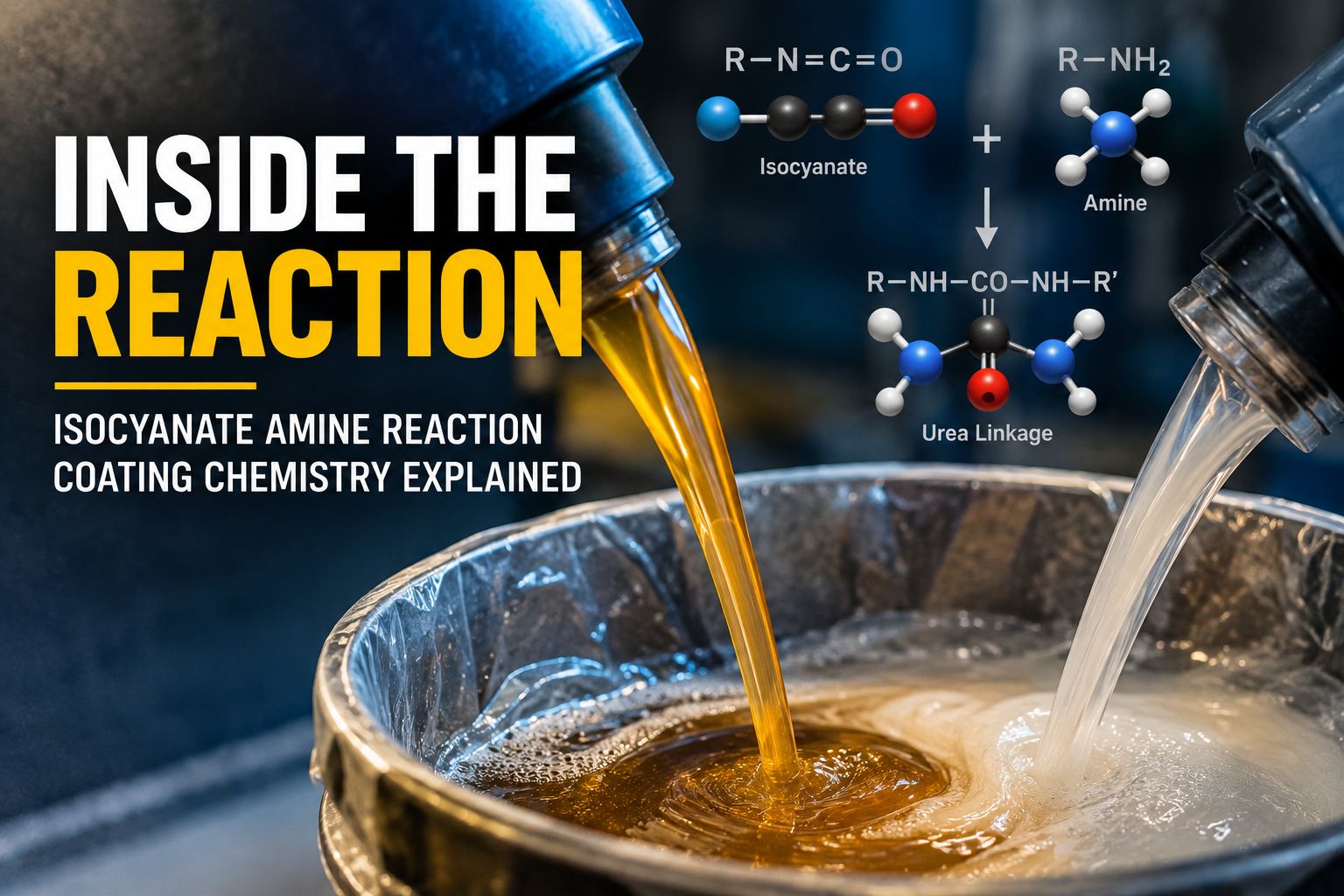
Isocyanates are the reactive backbone of this whole story. They’re built around a small, punchy functional group, -N=C=O, that’s hungry to react with anything that can hand it a pair of electrons. That hunger is what makes isocyanates useful across a surprising range of materials, not just coatings. Foam, adhesives, sealants, a lot of that traces back to isocyanate chemistry too.
Amines are the other half. Depending on how the molecule is built, an amine’s nitrogen atom can be a genuinely aggressive electron donor, which is exactly what an isocyanate is looking for. In a polyurea formulation, the resin side is built around an amine-terminated compound, sometimes a polyamine, sometimes an amine-terminated polyether. Whichever one gets used, it’s chosen specifically because of how eagerly it reacts with the isocyanate on the other side of the barrel.
It’s worth saying plainly that this pairing isn’t unique to coatings. The same isocyanate chemistry shows up in foam, adhesives, sealants, and plenty else. What makes a coating-grade formulation different comes down to which specific resin components get chosen and how they’re balanced, tuned to give a sprayed film the flexibility, hardness, and cure behavior a coating actually needs rather than what a foam or an adhesive would call for.
What Happens When They Meet
Put the two together and the amine’s nitrogen goes straight for the electrophilic carbon sitting in the isocyanate group. That reaction forms a urea linkage, and it doesn’t waste time doing it. Seconds, typically. No catalyst required. This is the actual mechanism behind an isocyanate amine reaction coating, and it’s why polyurea doesn’t act like most of the other coatings on the market.
Polyurethane tells a different story with the same starting material. Instead of an amine, the isocyanate reacts with a polyol, a hydroxyl-terminated compound. That produces a urethane linkage instead of a urea one, and since hydroxyl groups are weaker electron donors than amines, the reaction needs help; usually a catalyst, to move along at a usable pace.
That speed difference is where polyurea’s famous moisture tolerance actually comes from. Water reacts with isocyanate too, and when it does, it throws off carbon dioxide, which shows up as bubbling or foaming if it gets out of hand. Give a reaction more time, like the slower polyol reaction in polyurethane, and moisture gets more opportunity to crash the party. Polyurea’s amine reaction moves fast enough that it mostly wins the race before moisture has much of a chance to interfere. If you want the practical, job-site version of this comparison rather than the chemistry-first one, our piece on polyurea vs. polyurethane and why it matters covers how these two reactions translate into real performance differences on a project.
Amine Reactions vs. Polyol Reactions, Side by Side
The differences aren’t subtle once you line them up. Amine-isocyanate reactions gel in seconds; polyol-isocyanate reactions take minutes to hours. Pure polyurea skips the catalyst entirely; polyurethane usually needs one. Polyurea shrugs off ambient moisture during application; polyurethane is a lot more particular about humidity and substrate moisture. And the linkages themselves differ too, urea from the amine route, urethane from the polyol route, which is part of why two coatings that both start from an isocyanate end up feeling so different once cured.
| Factor | Amine + Isocyanate (Polyurea) | Polyol + Isocyanate (Polyurethane) |
| Resulting linkage | Urea | Urethane |
| Reaction speed | Seconds | Minutes to hours |
| Catalyst required | No | Usually |
| Moisture sensitivity | Low | Higher |
| Nucleophile strength | Strong (amine) | Weaker (hydroxyl) |
Then there’s the middle ground. Some formulations mix a polyol into the amine side deliberately, producing a hybrid polyurea that splits the difference on cure speed and moisture sensitivity. If you’ve ever wondered why “polyurea” on a spec sheet doesn’t always behave the same way twice, this is usually why. We got into that blend in more detail in pure polyurea vs. hybrid: how to tell what you’re buying, which is worth a read if you’ve run into that inconsistency yourself.
It Doesn’t Stop at One Reaction
Here’s the part that tends to get skipped in the simplified version of this story. The core amine-isocyanate reaction isn’t the only thing happening while a polyurea film cures. Excess isocyanate can keep reacting, this time with urea linkages that already formed, producing biuret linkages along the way. Those add extra crosslinking to the finished film, and crosslinking is not a minor detail. It shapes hardness, chemical resistance, how the material handles stress over time.
Formulators also play with different amine blends, some faster, some slower, to dial in gel time and working properties for whatever the coating actually needs to do. A fast-turnaround floor system and a thick tank lining don’t necessarily want the same balance. None of this changes the core reaction at the heart of polyurea chemistry, but it goes a long way toward explaining why “polyurea” as a category covers a real spread of behavior rather than one fixed product.
Think about what happens on two very different jobs. A crew coating a warehouse floor overnight wants a fast gel and a quick walk-on time so the space can go back into service the next morning. A crew lining a large tank wants enough working time to get even coverage across a big, awkward surface without the material grabbing before they’ve finished a pass. Both jobs are still fundamentally running the amine-isocyanate reaction, but the specific amine blend, and sometimes small additive packages layered on top, get tuned differently to fit what each job actually demands. That’s the part of the chemistry that doesn’t show up in a simple explanation of the reaction mechanism, but it’s a big part of why picking the right product for the job matters as much as understanding the chemistry behind the category in general.
Why Any of This Matters Once You’re Actually Spraying
This isn’t trivia. It shows up on the job. It’s why pure polyurea handles cold, damp, less-than-ideal conditions that would give a polyurethane crew real problems. It’s also why gel time leaves almost no margin for equipment or technique mistakes, since there’s no catalyst gradually easing the reaction along, buying you time to fix something mid-spray. And it’s a big part of why ratio control matters as much as it does. The amine and isocyanate have to meet in the right proportion for the reaction to actually finish the way it’s supposed to, and equipment that’s drifted out of calibration can throw that off in ways you won’t necessarily catch until the coating’s already cured and underperforming. Our equipment piece, application equipment questions answered, goes deeper into what that ratio discipline actually looks like with real proportioning gear.
A Few Things Worth Keeping in Mind
Isocyanates aren’t something to get casual around. They’re respiratory sensitizers, and anyone working near them should be following the specific product’s safety data sheet for ventilation and protective equipment, not general assumptions carried over from a different job. That’s not a footnote, it’s core to working with this chemistry responsibly, whether you’ve sprayed a thousand jobs or five.
The exact resin also isn’t identical from one manufacturer to the next. Small formulation differences show up in gel time, flexibility, and general performance, even between two products that both get called “pure polyurea.” The technical data sheet for whatever you’re actually using beats a general chemistry explainer like this one every time when it comes to specifics.
And the fast cure that makes polyurea so useful cuts both ways. Very little working time means very little margin to adjust technique once material starts flowing, which trips up plenty of applicators making the jump from a more forgiving, slower-curing system for the first time.
One more thing worth flagging: chemistry alone doesn’t clear a product for every use case. A polyurea intended for something like potable water contact needs its own specific certification tied to that exact product name. Knowing how the reaction works doesn’t substitute for checking whether the specific product you’re using is actually certified for what you’re using it for.
After the Cure: Does the Chemistry Still Matter?
Yes, more than people usually assume. The urea linkage that forms during cure gives polyurea a lot of its flexibility and durability, but what happens after cure still depends on how the coating was applied, how thick it went down, and whether it’s protected by a UV-stable topcoat. Chemistry sets the starting point. Application and upkeep decide how well that starting point actually holds up years down the line.
The crosslinking we talked about earlier keeps mattering here too. A heavily crosslinked film tends to be harder and more chemically resistant, but it can give up some flexibility compared to a less crosslinked one, which is one more reason two products both labeled “pure polyurea” can age completely differently under the same conditions, even when the install day looked identical.
Frequently Asked Questions
Why does polyurea cure so much faster than polyurethane?
Because the amine group on polyurea’s resin side is a much more aggressive electron donor than the hydroxyl group in polyurethane’s polyol, which lets the reaction fly without needing a catalyst to help it along.
Does the reaction produce any byproducts?
The main reaction just forms a urea linkage, no significant byproducts there. Side reactions, isocyanate meeting ambient moisture, can produce carbon dioxide, which is part of why moisture exposure and reaction speed both matter.
Is polyurea’s fast cure ever actually a downside?
It can be, mostly around working time. The same speed that gives you moisture tolerance and a quick return to service also gives you almost no room to fix technique once you’re spraying.
Are isocyanates dangerous to work with?
They require real respiratory protection and ventilation since they’re known sensitizers. Follow the specific product’s safety data sheet rather than assuming your last job’s setup is good enough here too.
Do all polyurea products share the same amine chemistry?
No. The specific amine resin varies by manufacturer, and that variation shows up in gel time, flexibility, and other properties even within what gets marketed as one category.
What’s a biuret linkage, and does it actually matter?
It’s a secondary linkage that can form when leftover isocyanate reacts with a urea group that’s already formed, adding more crosslinking to the film. It affects hardness and chemical resistance, and it’s a good example of why formulation details go beyond the headline amine-isocyanate reaction.
Conclusion
An isocyanate amine reaction coating gets its speed, its tolerance for moisture, and its catalyst-free cure from one reaction: a strong electron donor meeting a hungry isocyanate group and forming a urea linkage faster than almost anything can get in the way. Knowing that isn’t just satisfying curiosity. It explains why polyurea behaves the way it does in the field, why ratio control on your equipment matters as much as it does, and why the chemistry category alone won’t tell you everything about how a specific product performs. For that, the technical data sheet on whatever’s actually in the drum still has the final say.