
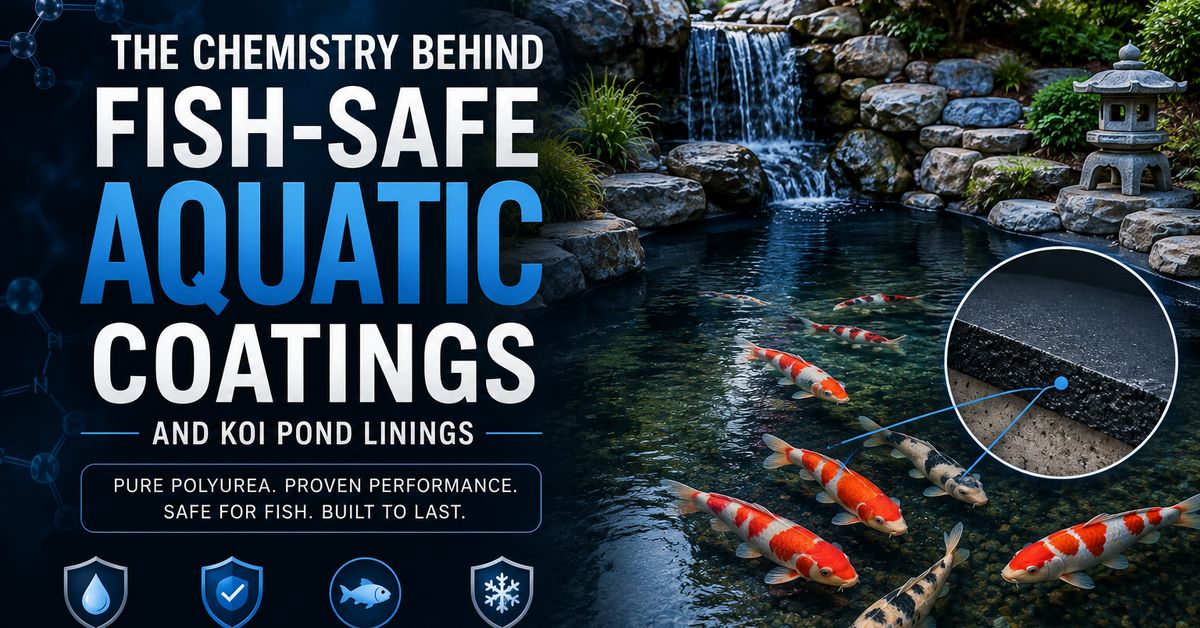
The Chemistry Behind Fish-Safe Aquatic Coatings and Koi Pond Linings
Ask a marketing department what makes a coating “fish safe” and you’ll get a label. Ask a chemist and you’ll get a much more specific answer: it depends on whether the film is fully reacted and whether the formulation ever contained anything mobile enough to migrate out of it. That distinction matters more in aquatic service than almost anywhere else a coating gets used, because the failure mode isn’t a stain or a shortened service life, it’s a dead koi collection and a pond that has to be drained, stripped, and redone.
This piece looks at the chemistry that actually decides whether an aquatic lining is safe for permanent immersion with livestock, why pure polyurea behaves differently from hybrid systems in this specific application, and what the relevant certification testing actually measures.
Why Immersion Chemistry Is a Different Problem From General Waterproofing
Most coating chemistry gets evaluated against intermittent exposure: wet, then dry, then wet again, with recovery time in between. Aquatic service removes that recovery entirely. The film sits saturated, often under real hydrostatic pressure, for years without a dry cycle. That changes which polymer properties actually matter.
Four chemistry-level requirements separate a genuinely aquatic-rated film from one that merely resists occasional moisture:
Hydrolytic stability. Some polymer backbones are vulnerable to slow hydrolysis, a reaction where water molecules break chemical bonds within the polymer over time. A coating that’s hydrolytically unstable will soften, blister, or chalk under permanent immersion long before it would show any wear from splash exposure alone. Polyurea’s urea linkage is generally more resistant to hydrolysis than the urethane linkage found in polyurethane, which is one of the chemistry-level reasons polyurea tends to be favored for permanent immersion work over polyurethane, even though the two are frequently confused as interchangeable. Our breakdown of the chemistry difference between polyurea and polyurethane covers this distinction in more depth.
Wet adhesion. Bonding to a dry substrate is a comparatively simple mechanical and chemical process. Holding that bond while the substrate stays saturated, with water actively trying to migrate along the interface, tests the coating’s actual bond strength under the worst realistic condition it will face. This is where substrate moisture testing before application becomes a chemistry issue, not just a workmanship one.
Post-cure inertness. A fully reacted, high-solids polyurea system has, in principle, nothing left to give up: no solvent to have evaporated incompletely, no unreacted monomer sitting in the matrix, no plasticizer added to achieve flexibility that the polymer itself doesn’t naturally have. This is the chemistry basis for the fish-safety claim, and it only holds true if the reaction actually went to completion.
Segmented elastomer flexibility. Polyurea’s flexibility comes from its segmented block structure, alternating hard and soft segments within the polymer chain, rather than from an added plasticizer. This matters specifically for leaching risk, since a plasticizer-dependent flexible film has an additive that can migrate out over years of immersion, while a segmented polyurea’s flexibility is structural rather than additive-dependent.
Where Toxicity Actually Comes From
“Fish safe” isn’t a regulated term, and understanding where coating-related fish toxicity actually originates is more useful than trusting a label.
Residual solvent is the most common cause of fish loss traced back to a coating. Solvent-borne pond paints can carry a substantial volatile fraction, and if the pond is filled before that solvent has fully evaporated out of the film, it goes straight into the water. Because 100% solids polyurea has no solvent to begin with, this failure mode is structurally eliminated rather than merely reduced.
Unreacted components result from mixing or metering errors rather than a chemistry flaw in the product itself. A two-component system applied cold, or through improperly calibrated equipment, can leave free isocyanate or free resin in the finished film. This is why plural-component spray equipment with calibrated proportioners is treated as a non-negotiable requirement for aquatic work rather than a nice-to-have, and it’s a large part of why DIY application is discouraged for anything beyond a small, low-stakes basin. Our equipment Q&A on application ratio, temperature, and pressure covers what proper metering actually requires in practice.
Plasticizer migration affects flexible films that rely on an additive for stretch rather than on their own polymer architecture. Over years of constant immersion, that additive can slowly work its way out of the film. Polyurea’s segmented structure sidesteps this mechanism entirely, since its elasticity doesn’t depend on anything added to the base resin.
Legacy biocide pigments, historically copper, zinc, or similar compounds used in marine antifouling coatings, are deliberately toxic to aquatic organisms by design. Any coating carrying this kind of pigment package has no place in a closed system like a koi pond, regardless of what else the formulation gets right.
Substrate leachate is a chemistry problem that originates outside the coating entirely. Fresh concrete and mortar are highly alkaline, often with a pH well above what most fish can tolerate, and can harm livestock on their own before a lining is even involved. A continuous, fully bonded coating actually resolves this by isolating the water from the cementitious substrate, which is a genuine chemistry-driven benefit beyond simple waterproofing.
The Certification That Actually Means Something
Because “fish safe” and “pond safe” carry no regulatory weight, third-party extraction testing is the only claim with real chemistry behind it. NSF/ANSI 61 testing works by soaking a cured sample of the coating and analyzing the resulting water for regulated contaminants against drinking-water limits. A product carrying that certification, under its exact formulation and product name, has been tested against a standard written to protect people drinking that water for decades, which is a meaningfully higher bar than anything implied by “pond safe” marketing language.
This certification needs to be verified for the specific product under consideration, not assumed from a manufacturer’s general reputation or from a related product’s certification. A formulation change, even a minor one, can affect whether a specific product still qualifies, which is why written, product-specific documentation matters more than a brand-level claim.
Pure Polyurea vs. Hybrid: Why the Distinction Matters More in Aquatic Work
“Polyurea” gets used loosely across the coatings industry, and the difference between a pure polyurea system and a hybrid formulation is where a lot of confusion, and a lot of real performance variation, actually lives. A hybrid system incorporates polyol or other components alongside the isocyanate and amine-terminated resin, which changes cure speed, moisture sensitivity, and, relevant here, the formulation’s overall chemical profile.
For general industrial or protective coating work, the pure-versus-hybrid distinction is often a performance and cost tradeoff. In aquatic service specifically, it can be a safety-relevant distinction as well, since a hybrid formulation’s additional components add more variables to the “did everything fully react and remain inert” question that fish safety ultimately depends on. Our detailed comparison of pure polyurea versus hybrid systems walks through how to tell which one is actually being quoted, since the terminology alone often doesn’t make it obvious.
Crack Bridging: The Elongation Number That Matters Underwater
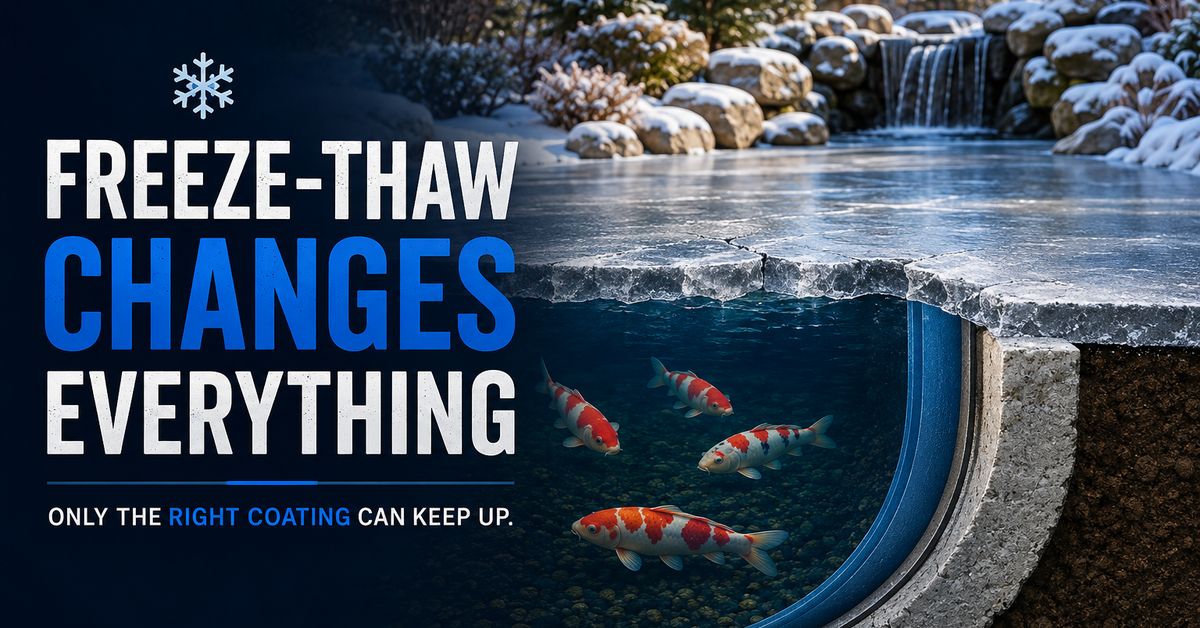
Concrete ponds move. Temperature swings, ground settling, and the sustained load of a full pond all place stress on the shell, and a rigid coating telegraphs that movement straight through as a crack. Elongation at break, the percentage a film can stretch before tearing, is the relevant chemistry-derived number here, and it varies significantly by coating family: rigid systems like standard epoxy or cementitious coatings typically measure in the low single digits, while elastomeric polyurea systems typically measure in the hundreds of percent.
That gap isn’t marginal. It’s the difference between a coating that bridges a hairline shrinkage crack invisibly and one that splits open along it. Published elongation figures are laboratory values measured against standards like ASTM D412, and they vary by specific formulation and film thickness, so confirming the actual figure against the current product data sheet before specifying a system matters more than relying on a general “polyurea is flexible” assumption.
Surface Preparation From a Chemistry Standpoint
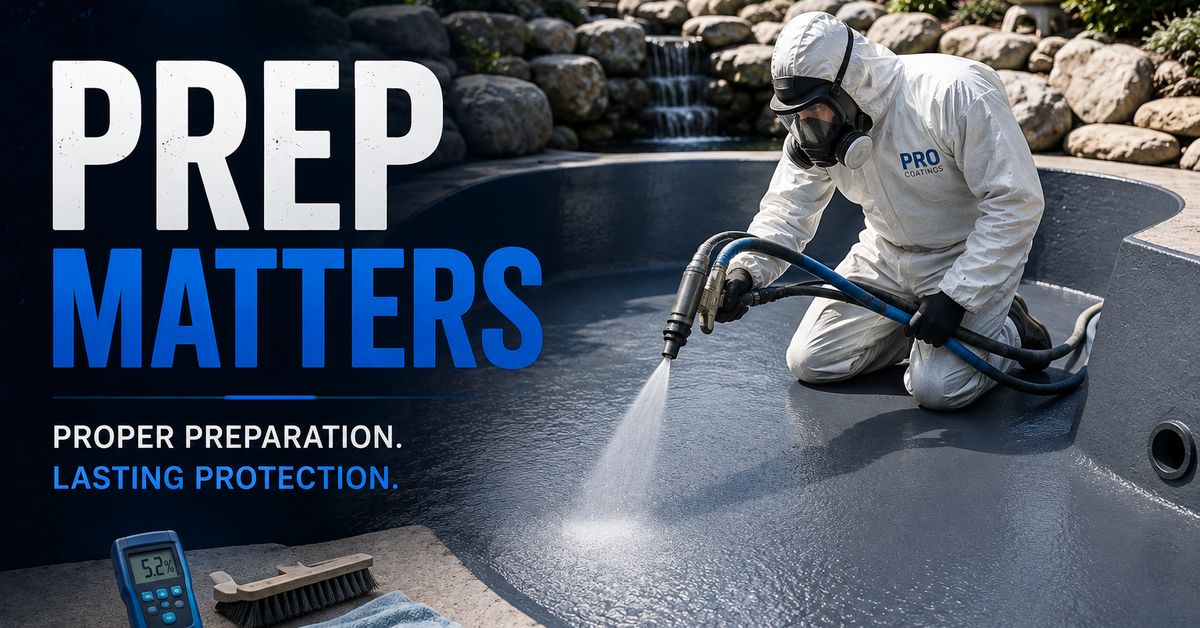
Most aquatic coating failures trace back to preparation rather than formulation, and understanding why helps explain why shortcuts here are so costly. Substrate moisture is the clearest example: concrete that appears dry to visual inspection can still hold enough internal moisture to generate vapor pressure beneath a freshly cured film, driving blistering or delamination regardless of how sound the coating chemistry itself is. Measuring moisture with a calcium chloride test or in-situ relative humidity probes, and comparing that reading against the coating manufacturer’s stated tolerance, is a chemistry-informed step, not a generic best practice.
Contamination removal matters for a related reason. Algae, biofilm, mineral scale, and residual oils on a substrate act as bond breakers at the molecular level, preventing the coating from achieving the intimate surface contact its adhesion chemistry depends on. No amount of product quality compensates for spraying over a contaminated or improperly profiled surface.
Things to Consider Before Specifying an Aquatic Lining
- Is the system pure polyurea or a hybrid, and does that distinction matter for this specific application’s safety and performance requirements?
- Has NSF/ANSI 61 certification, or the relevant certification for the application, been verified in writing under the exact product name being specified?
- What’s the documented elongation at break for the specific formulation, confirmed against the current product data sheet rather than a general product family claim?
- Has substrate moisture been measured rather than assumed, and does the reading fall within the coating manufacturer’s stated application tolerance?
- Is the application being handled with calibrated plural-component equipment, given how directly proper metering affects whether the cured film is genuinely inert?
Frequently Asked Questions
Why is polyurea generally considered more hydrolytically stable than polyurethane?
The urea linkage in polyurea’s polymer backbone is generally more resistant to hydrolysis than the urethane linkage in polyurethane, which matters specifically for permanent immersion applications where the coating never gets a dry recovery period.
Does a coating need to be pure polyurea to be considered for aquatic use?
Not automatically, but the distinction is worth understanding, since hybrid formulations introduce additional components that add variables to the inertness question fish safety ultimately depends on. Verifying exactly what’s being specified, rather than assuming from the word “polyurea” alone, is the more reliable approach.
What does NSF/ANSI 61 certification actually test for?
It’s a third-party extraction test where a cured coating sample is soaked and the resulting water is analyzed for regulated contaminants against drinking-water standards. It’s a substantially higher bar than unregulated terms like “pond safe” or “fish safe.”
Why does substrate moisture matter so much for aquatic coating chemistry?
Trapped moisture beneath a curing or cured film can generate vapor pressure that causes blistering or delamination, regardless of how well-formulated the coating itself is. This is a preparation issue with direct chemistry consequences, not a separate concern from the coating’s performance.
Can hybrid polyurea systems ever be used safely in aquatic applications?
Potentially, but each formulation needs to be evaluated on its own certification and documentation rather than assumed safe based on general polyurea marketing. The specific components and their inertness after cure are what matter, not the category label alone.
Conclusion
Fish safety in aquatic coatings isn’t a property that marketing copy can confer. It’s a direct consequence of polymer chemistry: hydrolytic stability, complete reaction, structural rather than additive-dependent flexibility, and verified inertness after cure. Understanding pure polyurea versus hybrid formulations, reading elongation figures correctly, and treating certification as something to verify at the specific product level rather than assume at the brand level are what separate a genuinely defensible aquatic specification from one built on label language alone.