
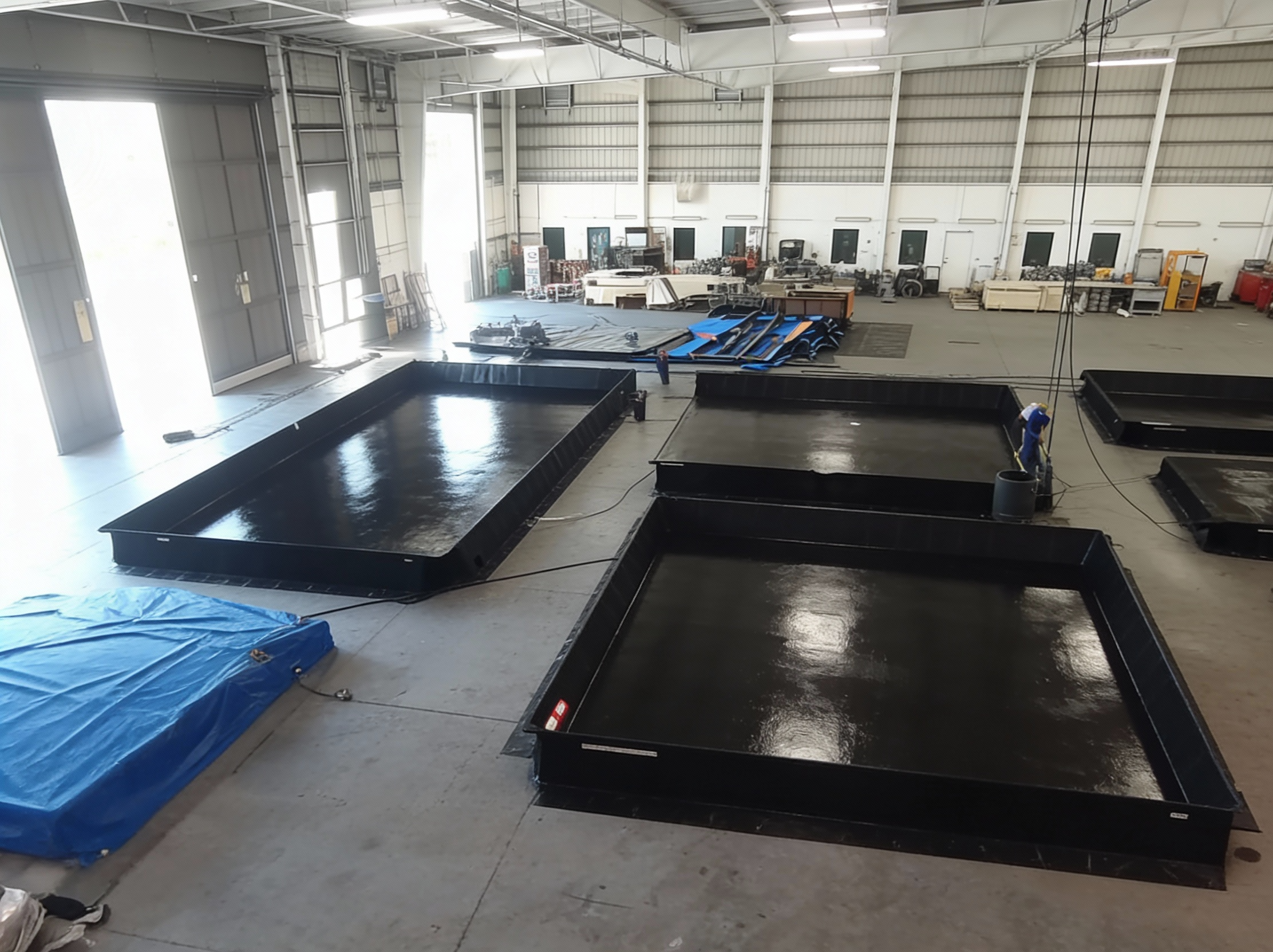
The Engineering Behind Polyurea Containment Mats: What Makes the Coating Outperform the Alternatives
Every containment mat has one job — hold what’s inside it and keep it from reaching the ground. That sounds simple enough until you consider what that mat actually goes through between deployment and decommissioning. The folding, the dragging, the standing chemicals, the temperature swings, the UV exposure, and the constant mechanical abuse from equipment and foot traffic all work against the membrane every single day it’s in service.
When a spill containment mat fails, the conversation shifts immediately from prevention to response. That shift is expensive, disruptive, and in many cases entirely avoidable if the mat was built with a coating that could handle the conditions it was placed in.
Polyurea has earned its position in the containment mat market not through marketing but through field performance. The chemistry behind the coating directly addresses the mechanisms that cause conventional mat materials to fail, and understanding those mechanisms is the key to understanding why polyurea works as well as it does in this application.
How Containment Mats Fail
Before talking about what polyurea does right, it’s worth understanding what goes wrong with the materials it’s replacing.
PVC containment mats fail through a few predictable pathways. Plasticizer migration is the most common — the chemical additives that keep PVC flexible gradually leach out of the material over time, accelerated by UV exposure and chemical contact. As plasticizer content drops, the membrane stiffens. Stiff membranes crack at fold points. Cracked membranes don’t contain anything.
Seam failure is the second most common issue across all mat types. Welded or heat-sealed seams create a stress concentration point where two pieces of material meet. Under repeated flexing, temperature cycling, and chemical exposure, those seams separate. On most conventional mats, the seam is the weakest link in the entire assembly, and it’s often the first thing to let go.
Puncture and tear propagation account for the rest of most field failures. A small puncture from a rock, a bolt, or a tool becomes a large tear when the membrane material can’t resist the propagation of that initial damage under tension. PVC and thin rubber compounds are particularly vulnerable to this failure mode because their tear strength drops as the material ages and stiffens.
Understanding these failure mechanisms matters because polyurea doesn’t just offer better numbers on a data sheet — it fundamentally changes the way the coating responds to each of these stresses.
The Chemistry That Makes Polyurea Different
Polyurea is formed through the reaction of an isocyanate component with an amine-terminated resin. That reaction happens fast — gel times are measured in seconds — and it produces a material with a unique combination of properties that set it apart from other coating chemistries used in containment applications.
The molecular structure of cured polyurea creates a dense network of urea linkages that give the material its characteristic combination of hardness and flexibility. Unlike PVC, polyurea doesn’t rely on plasticizers to maintain its flexibility. The elasticity is inherent to the polymer structure itself, which means it doesn’t degrade over time through chemical migration. A polyurea coating that’s flexible on day one is still flexible years later under the same conditions.
That structural stability is the foundation of everything else polyurea does well in containment mat applications. The elongation, the tear resistance, the chemical resistance, and the temperature performance all trace back to the fundamental chemistry of the urea linkage and the crosslinked polymer network it creates.
Material Properties in Context
Listing properties without context doesn’t help anyone make better decisions about containment mats. What matters is how those properties translate to real-world performance under the conditions containment mats actually face.
Elongation and recovery. Pure polyurea systems routinely achieve elongation values above 400%, with some formulations reaching significantly higher. But the number alone isn’t the point — what matters is that the material returns to its original dimensions after being stretched. A containment mat gets folded and unfolded dozens of times per season. Each fold cycle stretches the coating at the bend point. A material with high elongation but poor recovery develops permanent deformation at those fold lines, which eventually leads to thinning and failure. Polyurea’s elastic recovery means those fold cycles don’t progressively weaken the coating the way they do with thermoplastic materials.
Tear resistance and propagation. Polyurea’s tear strength is impressive on its own, but the more important characteristic is its resistance to tear propagation. In ASTM testing, polyurea coatings resist the spread of an initiated tear far more effectively than PVC or standard elastomeric coatings. On the jobsite, that means a nick from a sharp edge stays localized rather than running across the mat under load. For a containment mat deployed on rough terrain, this property alone can be the difference between a repairable mat and a total loss.
Chemical resistance. Polyurea resists degradation from a broad range of industrial chemicals including aliphatic and aromatic hydrocarbons, dilute acids and bases, glycols, and many common solvents. The resistance isn’t just surface-level — polyurea doesn’t swell or soften on prolonged contact the way PVC does with many hydrocarbons. That dimensional stability under chemical exposure means the mat maintains its mechanical properties even after extended contact with the fluids it’s designed to contain.
Temperature performance. Polyurea maintains its flexibility and mechanical properties across a service temperature range that covers virtually every industrial operating environment. From well below -40°C through sustained heat above 80°C, the coating doesn’t stiffen, crack, or soften in ways that compromise containment. For operations that deploy mats across seasonal extremes or in climate zones where temperature swings of 60 or 70 degrees happen routinely, that consistency eliminates one of the most common causes of conventional mat failure.
UV resistance. Aliphatic polyurea formulations offer strong UV stability, maintaining both appearance and mechanical performance under prolonged sun exposure. Aromatic formulations will discolor over time but generally retain their functional properties longer than PVC under equivalent UV loading. For mats stored or deployed outdoors for extended periods, the coating’s UV resistance directly affects service life.
How Polyurea Gets Applied in Mat Construction
The application process for polyurea containment mats involves heated plural-component spray equipment — typically a proportioning unit that meters the isocyanate and resin components at a 1:1 ratio by volume, heats them to processing temperature between 140°F and 160°F, and delivers them through a mixing chamber at pressures around 2,500 psi.
The spray process deposits the polyurea onto the fabric or geotextile substrate in a controlled pass pattern that allows the applicator to vary coating thickness across the mat. This capability is critical for containment mat construction because the high-stress areas — fold lines, seams, corners, and attachment points — benefit from additional coating thickness while the field areas of the mat can remain lighter.
Building up material at stress points during application is more effective and more reliable than adding reinforcement after the fact. The polyurea bonds to itself between passes, creating a monolithic coating without cold joints or adhesion boundaries that could become failure initiation points under stress.
Seam treatment with polyurea represents a meaningful improvement over conventional mat construction. Rather than relying solely on a heat-welded or adhesive-bonded seam, a polyurea overlay across the seam joint adds chemical resistance, flexibility, and tear strength to the most vulnerable point in the assembly. Some manufacturers apply polyurea both over and under the seam, effectively encapsulating the joint within the coating system.
Field Repair and Maintenance
One of the practical advantages of polyurea in containment mat applications is the ability to perform field repairs using the same chemistry that built the mat originally.
A damaged area can be cleaned, lightly abraded for adhesion, and repaired with a polyurea patch applied from portable spray equipment or even cartridge-dispensed systems for smaller repairs. The repair reaches functional cure within minutes, and the repaired section bonds chemically to the existing coating to create a continuous membrane.
For operations managing polyurea containment mats across remote or distributed sites, the ability to repair rather than replace a damaged mat reduces downtime, logistics costs, and the compliance risk associated with operating without adequate containment during a replacement cycle.
That repairability also extends the economic life of the mat well beyond what’s possible with PVC or rubber alternatives, where damage typically means full replacement rather than localized repair.
Standards and Testing Considerations
Containment mat performance should be verified against recognized testing standards, not just manufacturer claims. When evaluating polyurea-coated containment mats, several ASTM standards provide useful benchmarks.
ASTM D412 covers tensile strength and elongation of elastomeric materials, and results from this test provide baseline data on the coating’s mechanical performance. ASTM D624 addresses tear resistance, which is critical for understanding how the coating will respond to puncture and edge damage in the field. ASTM D2240 measures Shore hardness, which gives an indication of the coating’s surface characteristics and resistance to abrasion.
Chemical resistance testing per ASTM D543 or immersion testing against specific fluid profiles provides data on how the coating will perform under prolonged chemical contact. Temperature-dependent testing — particularly tensile and elongation data generated at low temperatures — is essential for any operation that deploys mats in cold climates.
Request test data generated on the actual mat construction, not just on free-film samples of the polyurea coating. The performance of the complete system — substrate, adhesion layer, and coating — can differ from the performance of the coating in isolation, and it’s the system performance that matters in the field.
Economic and Operational Considerations
The cost comparison between polyurea containment mats and conventional alternatives only makes sense when it accounts for the full lifecycle of the product in service.
Purchase price is higher for polyurea mats — that’s a straightforward fact and shouldn’t be obscured. But the service life difference changes the math significantly. A polyurea mat that delivers five to seven years of reliable service in the same conditions that destroy a PVC mat in eighteen months to two years represents a fundamentally different cost profile when measured on a per-year or per-deployment basis.
Replacement logistics carry their own costs, particularly for operations managing containment across multiple or remote sites. Every mat replacement requires procurement, shipping, site delivery, installation, and disposal of the failed mat. Reducing the frequency of those replacement events across a fleet of containment systems generates savings that compound over time.
Compliance risk has a cost as well, even if it’s harder to quantify on a spreadsheet. A mat that fails during a spill event exposes the operator to reporting obligations, investigation costs, potential remediation expenses, and regulatory penalties. The reliability of the containment system directly affects the probability and magnitude of those costs.
Where the Material Fits in the Broader Containment Conversation
Polyurea containment mats represent one application within a much larger shift toward high-performance protective coatings across industrial infrastructure. The same chemistry protecting containment mats is used in secondary containment linings, wastewater treatment facilities, pipeline coatings, bridge deck membranes, and dozens of other applications where durability under harsh conditions is the defining requirement.
That breadth of application experience gives polyurea a track record that newer or more narrowly applied materials can’t match. The coating has been tested across enough environments, chemical exposures, and mechanical stresses to provide a high degree of confidence in its performance across containment applications.
Containment mats aren’t the most visible piece of equipment on any jobsite, but they carry outsized importance when something goes wrong. Building them with a coating that can absorb the punishment of real field conditions — and keep performing year after year — is the most straightforward way to reduce the risk, cost, and operational disruption that come with containment failures. The engineering behind polyurea makes that durability possible. The field record confirms that it delivers.